
The Angono Petroglyphs are images carved in a rock wall that can be found along the boundary of Angono and Binangonan. It is considered as the oldest work of art in the Philippines.
It was one of those fine, sunny days perfect for a road trip. With a number of places to visit in Rizal, we chose the humble province for a quick drive from Manila. One of our stops – the Angono Petroglyphs.

Going to Angono Petroglyphs, we initially though we’re lost. It was like driving on empty road, there were not much landmarks or structures along the way. It felt like going on a countryside and that Angono Petroglyphs was somewhere hidden. But we made it.

Angono Petroglyphs Tunnel
From the parking area, we started walking our way until we reached a tunnel. I thought going through the dark tunnel was really cool, aside from the fact that it was literally cool inside the tunnel. I don’t know why but I was sort of imagining it was a cinematic place for a zombie attack, lol.

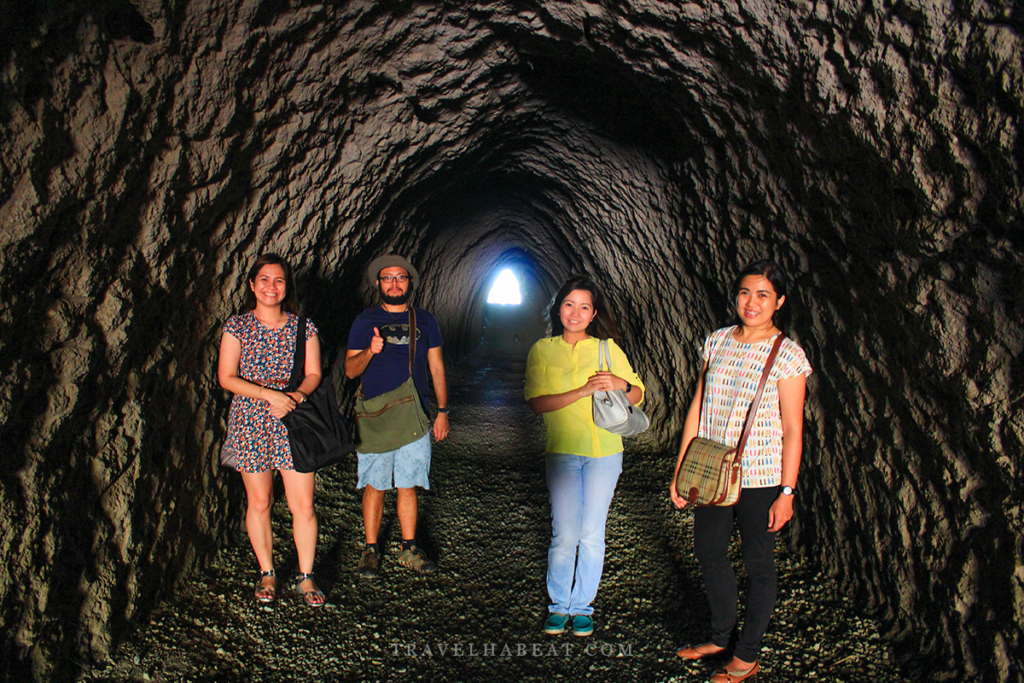

It was quite a long walk from the parking lot and it was such a scorching day. Until we finally reached the viewing deck of Angono Petroglyphs.
Angono Petroglyphs Rock Art
The viewing deck is a long stretch of wooden platform where you can see closely the petroglyphs or the images carved in the huge rock wall. Angono Petroglyphs is found in a shallow rock shelter measuring about 63 meters wide, 8 meters deep, and 5 meters at the highest point. There are 127 drawings in the form of animate figures.

Among the carvings, you can sight human figures and animals. Some of the engravings had faded a bit but there are still more you can recognize. It was just unfortunate to see some vandalism in the rock wall.

Examining the drawings, they concluded that many individuals created it. The Angono Petroglyphs consisting of static figures was also believed to be associated with ancient rituals.

Accidental Discovery of Angono Petroglyphs
National artist Carlos Francisco accidentally discovered the Angono Petroglyphs. He was on a field trip together with some boy scouts. They rested on a rock shelter located in the hills between the boundary of Angono and Binangonan that was used by Filipino guerillas during the Second World War. While lying down, he noticed some drawings etched on the rock wall which he thought looked primitive.
When he returned to town, he inquired about the carvings he saw to some of the old residents of Angono. Though the people knew about the petroglyphs found in the rock shelter in the hills, they actually do not recognize anything about its significance.

Carlos Francisco then reported the petroglyphs to the National Museum considering that the primitive drawings may actually possess an important cultural and historical value. In 1973, Angono Petroglyphs was officially declared as a National Cultural Treasure by the National Museum of the Philippines.
At present, the Angono Petroglyphs has become a known Rizal tourist spot.
Overall
Angono Petroglyphs may not be for everyone. Some people get disappointed when they see the drawings where some are even faded especially having to drive to its distant location along the hills. Understand that they are simple rock carvings that may have been created during the Neolithic age. Angono Petroglyphs have such essential historical value but on the outside, they are just that – simple, primitive drawings. Don’t expect an extraordinary sight.

I’m not a huge archaeology fan but personally, I found the site interesting and unique. It was indeed an effort to drive to the place but it felt like we were hunting an ancient treasure.
Looking for Rizal hiking spots? Check Masungi Georeserve.
